
Microplastics in wastewater treatment plants: from measurement protocols to removal efficiency
Microplastics are an emerging pollutant whose spread in the environment poses a serious risk to human health and ecosystems. Despite the increasing number of studies on this topic, updates to current regulations and the implementation of effective solutions to limit their dispersion are still under discussion.
In urban contexts such as our cities, wastewater treatment plants represent the collection point for microplastics originating from domestic discharges or transported by urban runoff, both surface and sewer. If not effectively removed during the various treatment stages, they are released back into the environment, compromising the quality of rivers and, ultimately, the seas. Several critical issues must be addressed in the coming years to find effective solutions to this problem. Among these, there is an urgent need to define rigorous and universally accepted methods for both sampling and analyzing microplastics at the inlet and outlet of treatment plants.
To begin clarifying these aspects, Eco Research took part in a study coordinated by the Department of Civil, Environmental and Mechanical Engineering (DICAM) of the University of Trento. The aim was to apply a specific protocol for analyzing microplastics at the inlet and outlet of treatment plants, comparing the removal efficiency of different treatment types. In addition to providing an overview of the qualitative and quantitative composition of microplastics at the plant inlet and outlet, the results also deliver initial technical insights into both the validation of the protocol and the removal efficiency achievable through current treatment stages – on average above 97%. However, the study also highlights further challenges, such as the release of microplastics during the treatment stages themselves from machinery and filtering systems, significant residues in treated water, and, above all, their accumulation in sewage sludge, with considerable implications for its reuse in agriculture.
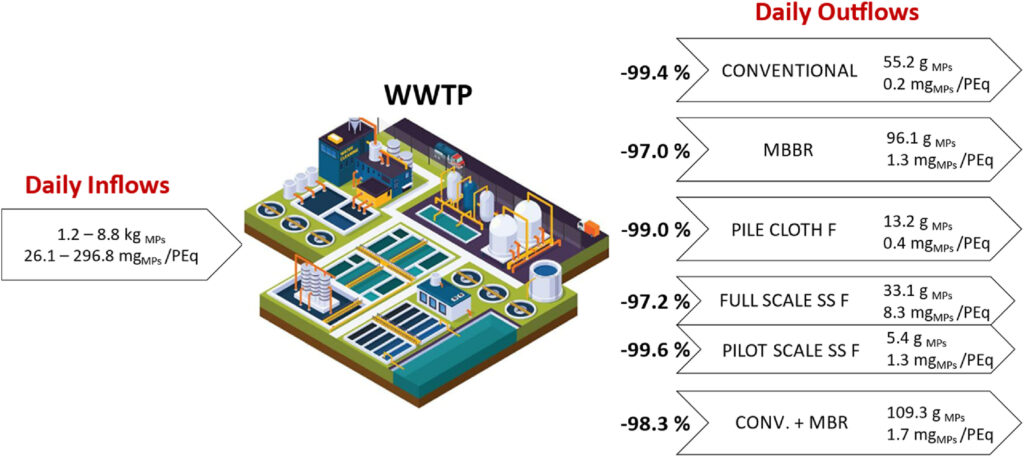
Summary diagram showing the minimum and maximum amounts of microplastics entering different wastewater treatment plants, the values per population equivalent, and the estimated daily emissions into receiving water bodies.
A B S T R A C T
Wastewater treatment plants (WWTPs) play a crucial role in removing microplastics (MPs) originating from urban areas. However, despite high removal efficiencies, WWTPs systematically release MPs into the environment through effluents. Beyond their direct ecological impact, MPs can act as carriers of micropollutants and pathogens. This study quantifies and characterizes MPs, including polyethylene, polypropylene, polystyrene, polyvinyl chloride, polymethyl methacrylate, and bio-based polymers, in the influent and effluent of five municipal WWTPs employing different treatment technologies. The selected WWTPs include a conventional activated sludge (CAS) system, a moving bed biofilm reactor, two plants with tertiary filtration (pile cloth and stainless-steel filters), and a hybrid CAS/membrane bioreactor (MBR). The study aims to systematically assess MPs removal efficiencies by applying a standardized method for sampling, preparation, and analysis. In-situ sampling was conducted using a pumping and filtration system capable of capturing MPs as small as 2 μm. Samples were treated with Fenton oxidation and density separation to eliminate potential interferences before polymer identification via thermal desorption gas chromatography-mass spectrometry (TD-GC/MS). MPs concentrations varied across WWTPs but remained within a relatively stable range (215.0–761.5 μg/L), corresponding to daily MP loads of 1.2–8.8 kg entering the plants. Polyethylene was the most abundant polymer in wastewater. Removal efficiencies varied by treatment technology, with MBR and tertiary filtration achieving the highest removal rates (>99 %), unexpectedly followed by the CAS WWTP, which exhibited an MPs removal efficiency of approximately 99 %. Per capita MPs loads ranged from 26.1 to 296.8 mg/day in influents and 0.2–8.3 mg/day in effluents, depending on plant capacity and daily load. Despite high removal rates, WWTPs continue to discharge significant MPs quantities, particularly given that major polymers such as polyethylene terephthalate and polyamides were excluded from this analysis. This highlights the need for continuous MPs monitoring and improved removal strategies. Additionally, this study did not investigate sludge samples. However, MPs removal in WWTPs is strongly associated with their accumulation in sewage sludge, raising concerns about their fate during sludge disposal and potential environmental impacts. Further research on MPs present in both WWTP effluents and sludge is essential to fully assess their risks to human health and ecosystem integrity.